- Saving Sundays
- Posts
- This too shall pass | 4-5 min read
This too shall pass | 4-5 min read
How to move forward in the face of rejection

Tyler Wade
February 01, 2026
The story
Hey, you’re there. We’re here. The present is a gift
Happy Sunday.
I hope you're holding up okay.
Today’s newsletter is about the job hunt, but it applies universally to life and your happiness. You don't find happiness. You practice it alongside uncertainty.
There's a particular kind of quiet that comes with unemployment.
It’s not peaceful—It’s the hush of a dark, damp, eerie basement—there’s no monster waiting, but try telling your brain otherwise.
It’s the self-talk, the rumination, the automatic negative thoughts.
It’s staring into the bright screen of your laptop at midnight, scrolling job boards of positions you’ve already applied to, already been rejected from.
It’s a full-time job being without a job. The longer it goes, the more your brain conjures worst-case scenarios.
It’s incredibly isolating, but neither you nor I is alone.
Allison Colin-Thome, a recruiter whose job title is “Candidate and Employee Experience Advocate,” knows that quiet (and it resonated with many).

After her post went viral, I reached out to speak with her.
Before she sat on the other side of the hiring table, nearly a decade ago, she was laid off from a major company.
Being unemployed is akin to life or death in your mind. It hits your nervous system in the same way.
Why job hunting feels impossible right now
In 2025, Canada's job-finding rate dropped to 18.1%—down from 21% the year before and 24% pre-pandemic. That means people are landing roles more slowly than they did five years ago.
Long-term unemployment (six months or more) is rising. Youth unemployment hit 25-26%, up from 21%. Job postings are down year-over-year. Recruiters are flooded with resumes, so they're relying more on automated screening.
A Canadian study of over 10,000 people found that unemployed Canadians report significantly lower mental health, lower confidence, and higher stress. There's a feedback loop at play:
According to Express Employment Professionals in Canada, recruiters report that repeated rejection leaves people feeling "defeated," "deeply frustrated," with a strong hit to self-worth

A rejection is rarely a verdict on you.
After so many final round rejections, your self-esteem takes a beating. As my therapist reminded me, though, “It’s not you.”
It's timing, budgets, internal candidates, or roles being reshaped mid-process. Tighter filters: someone with 5 years of experience gets through, but not your 4.
Allison sees it constantly. "It's unprofessional to send a generic rejection email," she says. But she also knows what's happening behind the scenes: hiring teams overwhelmed, employer brand concerns, impossible expectations.
Understanding that intellectually is easy. Believing it emotionally? That's the work.
The AI problem that has no one talking
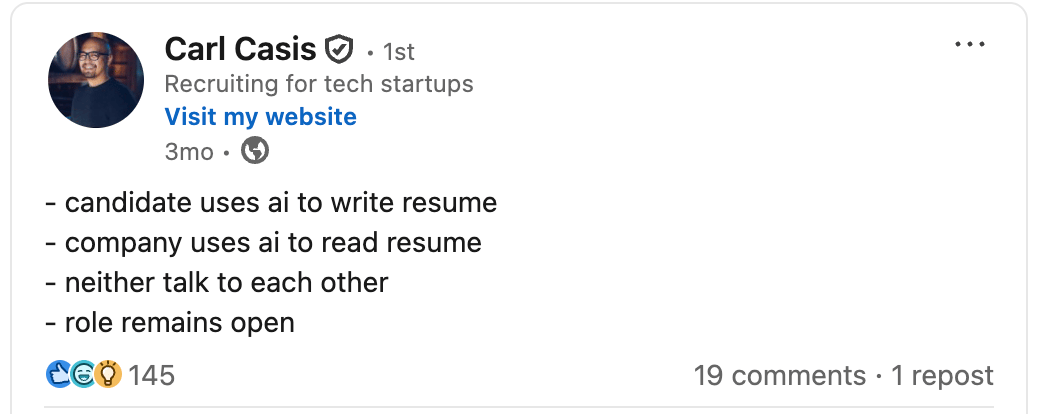
So, what else, besides a clean, clear resume with impactful numbers, actually cuts through?
Allison believes it’s real conversations with real humans
Networking isn't dead.
But you don't need expensive coffee chats with strangers or LinkedIn pitch-slapping someone you've never met.
You need connection.
A walk with a friend who knows someone. A call with a former coworker who misses you. A message that says, "I'm figuring things out. Would love to catch up."
Support counts. Conversation counts. And it shouldn't feel like work.
You can't wait to get into these situations and then look to do what you can. Think of your relationships like an emergency fund. Like a savings account. You have to anticipate one day that you're going to need support from other people. So I think your relationship currency and looking at the long-term strategy of building those relationships and nurturing those relationships over time is really the best thing you can do.
The Pebble
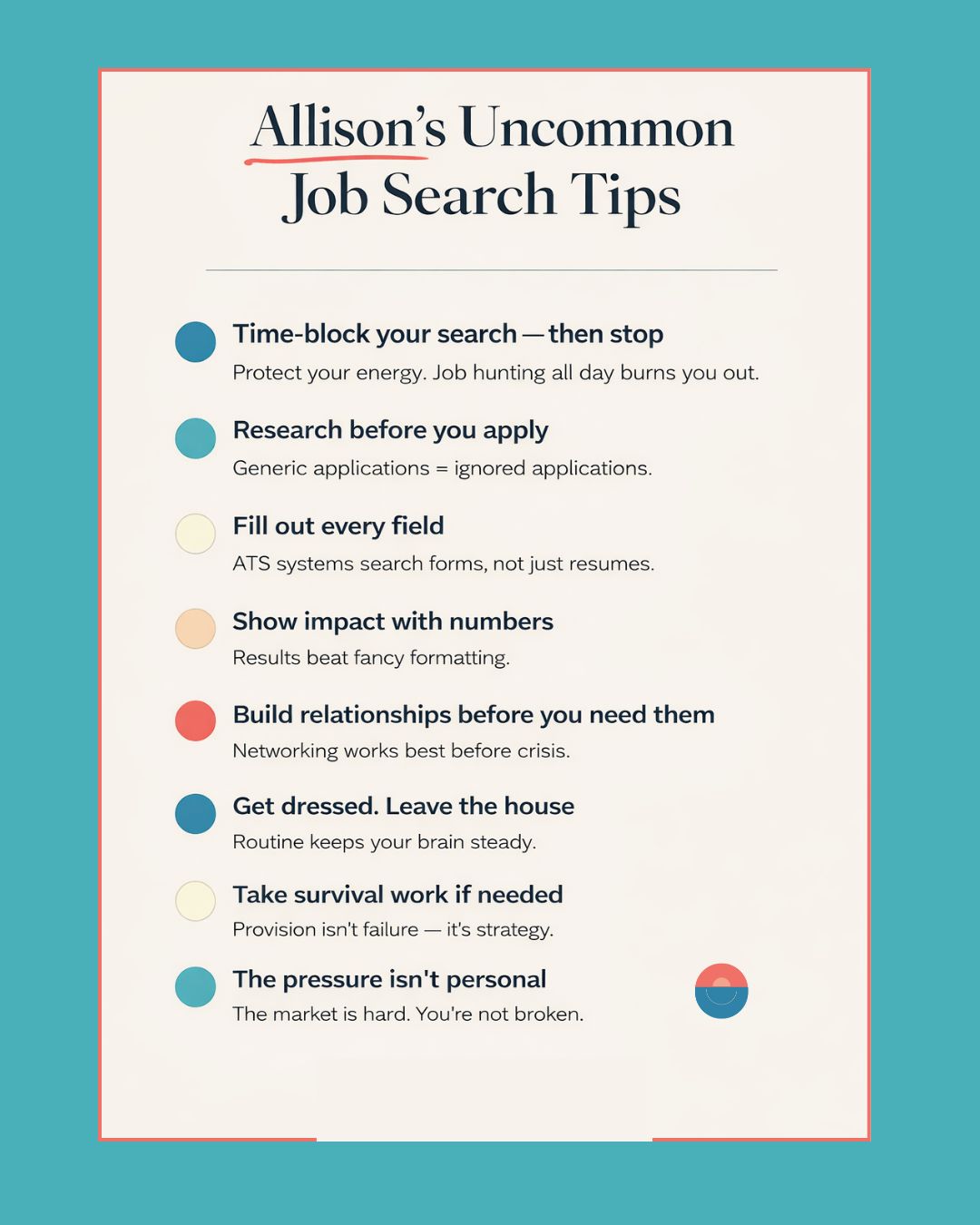
Allison's uncommon tips for job seekers
1. Time-block your job search (then stop)
"I actually time-blocked. I would allot a certain amount of time in the day to apply to jobs, to search for jobs, and then I would do whatever I need to do for the rest of the day, whether that's meeting up with people, or trying to exercise or make sure I'm getting dressed in the morning and out of the house."
2. Do your actual research before applying
"I can't even tell you the number of candidates that I get on the phone with, and I ask them what they know about Ratehub, and they don't know anything. So don't waste your time as a candidate."
3. Fill out every single field in the application
"Even if it's repetitive and it asks you to put in the same information that's on your resume, I know it's tedious, but fill it out because that's going into a database, and that database is being used to search for candidates and the keywords."
4. Make your resume show impact with numbers
"If I can't tell what you did in 10 seconds, I'm moving on."
5. Build your relationship emergency fund before you need it
"You can't wait to get into these situations and then look to do what you can. You have to anticipate one day that you're going to need support from other people. So I think your relationship currency, and looking at the long-term strategy of building and nurturing those relationships over time, is really the best thing you can do. It's like a savings account. Putting away for a rainy day."
6. Get dressed. Leave the house. Stay human.
"Make sure [you’re] getting dressed in the morning and out of the house... meeting up with people, trying to exercise."
7. Take survival work if you need to (without shame)
“You need to provide for your family and pay bills—whatever it takes. How you frame it matters. Taking any honest job to support your family isn’t a step down. Anyone who judges that reveals misaligned values. When I see survival work on a resume, it impresses me—it shows character. Those who’ve faced the least hardship tend to complain the most.”
8. Remember: The pressure compounds, but it's not about you
“Extended unemployment compounds stress exponentially. Your nervous system registers it as a survival threat, making each interaction feel increasingly high-stakes.”
The challenge
This week, try this (even if you’re employed, because you never know)
1. Update your resume for impact
Add percentages. Add dollar figures. Remove fluff. Make it legible, honest, and human. One strong resume beats ten rushed ones.
2. Time-block your days
Time block work, networking, and resume writing. If you’re in the struggle, it provides meaning.
Then, time block 1 hour for something that fills you up. A walk. A call. A book. A nap.
3. Schedule one real connection
Not a pitch. Not a strategy session. Just a conversation.
Text someone: "Hey, I'm in a weird spot. Can we talk?"
You don't have to do this alone. Be purposeful. Make it easy to say yes. Don’t put the work on them to help you. Help yourself by helping them.
Until next week,
Saving Sundays
P.S. If this resonated, forward it to someone who might need it. Someone who's been quiet lately. Someone applying alone at home. Let them know they're not invisible.
