- Saving Sundays
- Posts
- Who are you, uninterrupted?
Who are you, uninterrupted?
How to get 1% better (not crushed by New Year's goals)

Tyler Wade
December 28, 2025
Happy end of the year!
Now that we’ve loaded up on food and booze, time to burn through 21 days of resolutions before we crash on Blue Monday, right?
Or maybe, this year, we do it differently.
Who are you, uninterrupted?
My wife rolls out of bed at 5:30 AM like it's nothing.
No negotiation. No snooze button. Just… up.
This Saturday, I beat her downstairs… for once. It typically happens when I haven’t slept at all. But this time, twenty minutes of huffing through a workout. I felt proud and sore from too many lunges.
She walks past me, still catching my breath. "Who are you, me?"
Then she went for a run. In the freezing cold. Me? I tried to stick to some of my to-do list from the night before, but defaulted to playing vids with my son.
Why does my wife always stick to her “resolutions” or “goals,” but I never do?
I've tried every New Year's resolution system. The 30-day challenges. The vision boards. The accountability apps. That rule about never missing two days in a row? Works great. Until you miss those two days.
Then it's over.
My vision of myself? I want to journal. Meditate. Work out. Focus deeply on work. Be present with my kids. Cook healthier meals. Read more. Scroll less.
It's too much. It's always too much.
And somewhere around Blue Monday—that third Monday in January when resolutions go to die—I'm back to my old patterns. Again.
So this year, it’s time for another new approach, science-backed, and how I’ll stick to it.
Our brains aren’t designed for success. They’re designed to keep us safe.
Safe means familiar. Safe means comfortable. Safe means avoiding hard, boring, or uncertain things.
That's why discipline feels exhausting. You're fighting millions of years of programming that says, "Don't do the uncomfortable thing. It’s hard, it aches, it hurts.
But here's what my wife understands that I don’t: your brain is trainable.
Not through motivation. Not through inspiration. Through repetition.
When you do something hard, your brain learns you can survive it. Do it again, and the hard thing doesn't get easier—you get stronger. Your nervous system updates its story about who you are.
James Clear calls these identity-based habits. You don't rise to the level of your goals. You fall to the level of your systems. More importantly, you fall to the level of your identity.
My wife isn't disciplined because she wants to be. She's disciplined because that's who she is. Her brain has proof.
Mine doesn't. Yet.
A deeper question
Before you set any goal, answer this:
Who are you, uninterrupted?
No meetings. No obligations. No one is watching. No one was expecting anything.
What are you doing with your time? Who are you with? What hobbies are you pursuing? What are you eating?
Most resolutions fail because they're just tasks we think we should do. Lose weight. Save money. Be more productive.
But if those things aren't connected to who you actually want to be, they won't stick.
My wife doesn't work out because she set a goal. She works out because she takes care of her body. That's the difference.
So instead of asking "What do I want to achieve in 2026?" ask "Who do I want to be in 2026?"
Then build one small habit that proves you're already that person.
The 1% Rule ( or how to not fail this time)
You can't improve 500% in 30 days. You can't become a new person by February.
But you can get 1% better every day.
One habit. One month. That's it.
Not ten priorities. Not a complete life overhaul. One thing.
January: I'm going to work out for 10 minutes, three times a week.
February: I'm going to journal for 5 minutes every morning.
March: I'll build on what's working.
Small, controlled discomfort. Just enough to teach your brain you can do hard things.
Because here's the truth about those hard things: they don't get easier because they change. They get easier because you change.
Every time you show up when you don't feel like it, you're adding evidence. Your nervous system is rewriting its story. And eventually, discipline stops feeling forced.
That's what my wife figured out years ago.
That's what I'm figuring out now.
Your Pebble: The Habit Tracker
We made you something.
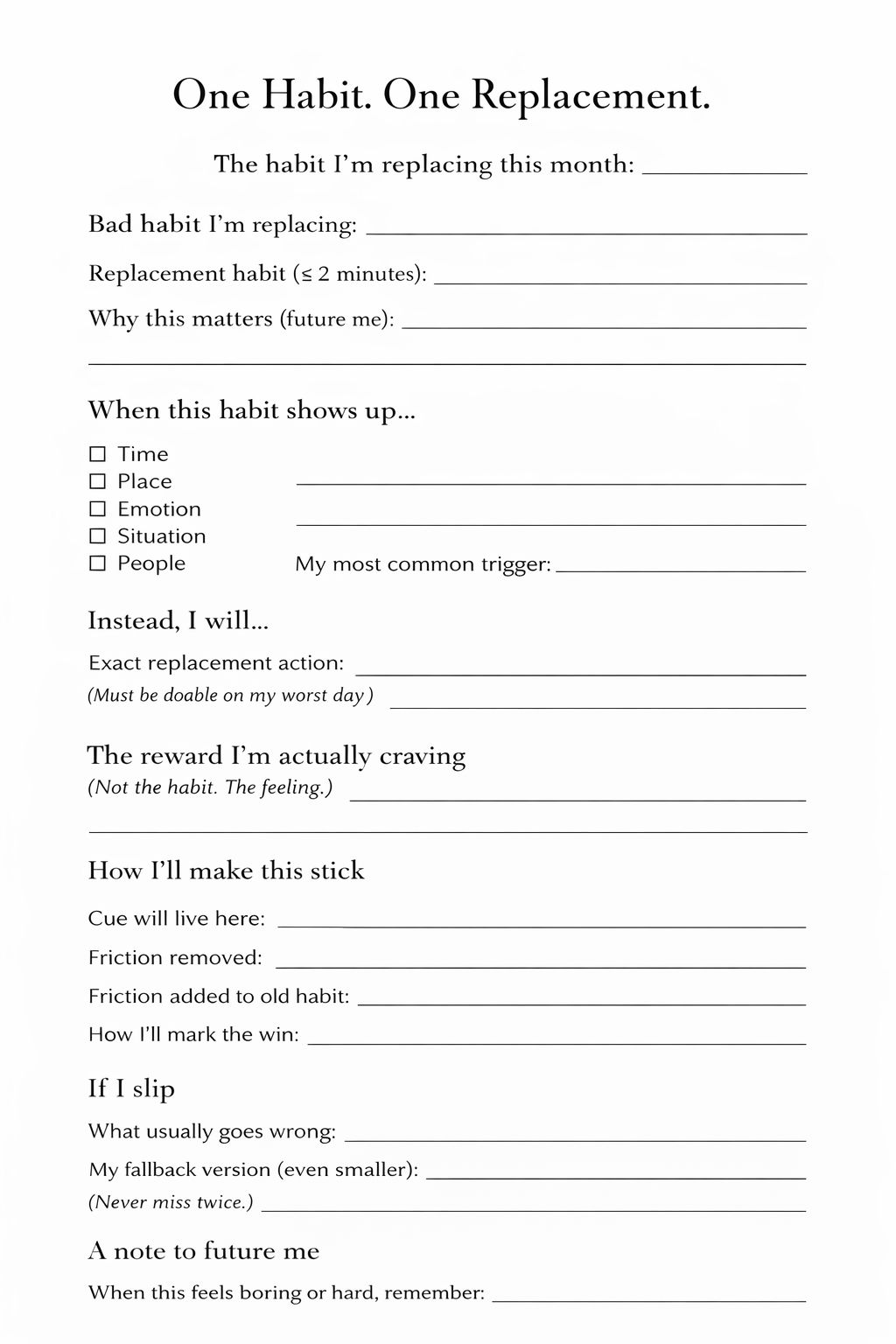
A simple one-page habit builder based on James Clear's formula. Pick your ONE habit for January. Write down your trigger. Identify the bad habit you're replacing. Track your progress.
Keep it visible. Check in daily. Ask yourself: "Does my behaviour today support who I want to become?"
Your Challenge: Choose your one thing
This week, decide on one habit for January.
Not five. One.
Something small enough that you can't talk yourself out of it. Something that proves you're the person you want to be.
Then do it. Just once. Tell your brain who's in control.