- Saving Sundays
- Posts
- The fisherman test | 6 minute read
The fisherman test | 6 minute read
We’re automating our way toward the life the fisherman already had.

Tyler Wade
March 08, 2026
Hey Sunshine,
Happy daylight saving time.
Historically, the idea was simple: use the sun to reduce electricity use.
It was adopted during the World Wars to save fuel for the war effort.
But the modern promise is different.
Longer evenings.
And that’s where our story begins.
The story
My wife swapped a 4-year-old Fitbit this week for a Garmin. Her Fitbit, she joked, made her Strava look like she was running away from a murderer - jittery and scattered. She escaped, but the Fitbit had counted its last step.
With her Garmin, her distance, step count, pace and heart rate were correct. As she trains for her next half-marathon, it’s a game-changer.
I admire her love and passion for the sport, her sleep optimization, and her breaking personal records.
This week, I broke a few records of my own, but without the same joy.
I was building things in hours that used to take days, juggling clients, managing politics, navigating personal dramas and competing pressures. At one point, I caught myself thinking, "I have never worked this fast in my entire life."
And immediately after that thought came another one: I am still letting people down. More people, faster, at greater scale.
"I have never worked this hard or this fast. And somehow I still feel like I'm not enough."
After getting married, he took some time off and spent a few months going deep into AI.
Really deep.
He was showing me how he builds full brand kits with a few prompts, generates motion graphics by writing code that talks to other code, and builds entire websites in a tool called Pencil.
He was lit up the same way my wife was lit up about her Garmin.
And I sat there thinking: where does this end? Is this the way we’re supposed to be living?
When the lightbulb was invented, factories didn't close early in celebration. They ran 24 hours. We didn't use that found time for stargazing. We used it to produce more.
And I kept coming back to an old parable — you probably know it. A businessman visits a small fishing village and finds a fisherman playing guitar, singing with friends in the evening, and a small catch already sold. The businessman lays out a vision: buy more boats, hire a crew, build a company, sell it, retire wealthy. "And then what?" asks the fisherman. "Then you can relax," says the businessman. "Play guitar. Sing with your friends." The fisherman smiles. "That's what I was doing when you arrived."
Here we are, all of us, automating our way toward the life the fisherman was already living.
What the research says
There's a word for how my week felt: optimized.
Writer Tessa R. has a name for what's wrong with that.
In her essay Optimization and Its Discontents, she traces our obsession back to the Industrial Revolution — the moment human labour stopped following the rhythms of the body and the seasons and began following clocks and assembly lines.
That's when time became money. And that's when we started treating ourselves like machines.

The word "optimization" entered everyday language in the 1950s, in the aftermath of WWII, as governments and corporations tried to rebuild at scale.
Engineers maximized supply chains. Algorithms replaced intuition. And gradually, that logic — born from war, math, and industry — began to shape how we think about everything: work, health, relationships, sleep.
The philosophy is seductive in its simplicity: if something can be measured, it can be improved. If it can be improved, it should be optimized. But buried in that logic, she writes, is "a quiet violence — a stripping away of the slow, the relational, the non-linear, the sacred."
Trying to hit your step goal can ruin the simple pleasure of a walk. Fixating on your sleep score can keep you awake at night. The tools meant to make you better can leave you feeling like you're never enough.
This is the trap Tim Ferriss — yes, the 4-Hour Workweek guy — admits to falling into after 20 years of writing and living self-help.
In a quietly devastating essay, he names the core flaw: "To continually improve yourself, you must continually locate the ways you are broken."
In a culture that rewards problem-solving, you can end up inventing problems just to have something to fix. He calls this becoming a SOMO — a self-obsessed masturbatory ouroboros. A snake eating its own tail.

Sticker from Porous Walker.
Maslow’s lost level
You know Maslow's pyramid: physiological needs at the base, self-actualization at the top. But most people don't know that Maslow revised his own theory late in his life.
He added a sixth level above self-actualization: Self-Transcendence. It’s a connection to something beyond the self. Service. Nature. Art. Faith. Other people.
Viktor Frankl, the Austrian neurologist, psychiatrist, philosopher, Holocaust survivor, and author of the phenomenal book, “Man’s search for meaning,” put it even more sharply: self-actualization is not a goal you can aim at. It is only ever a side effect of forgetting yourself in service of a cause, a person, a moment larger than you.
In other words, the more intensely you optimize for yourself, the further you get from the thing you were actually looking for.
Hamburger > pyramid
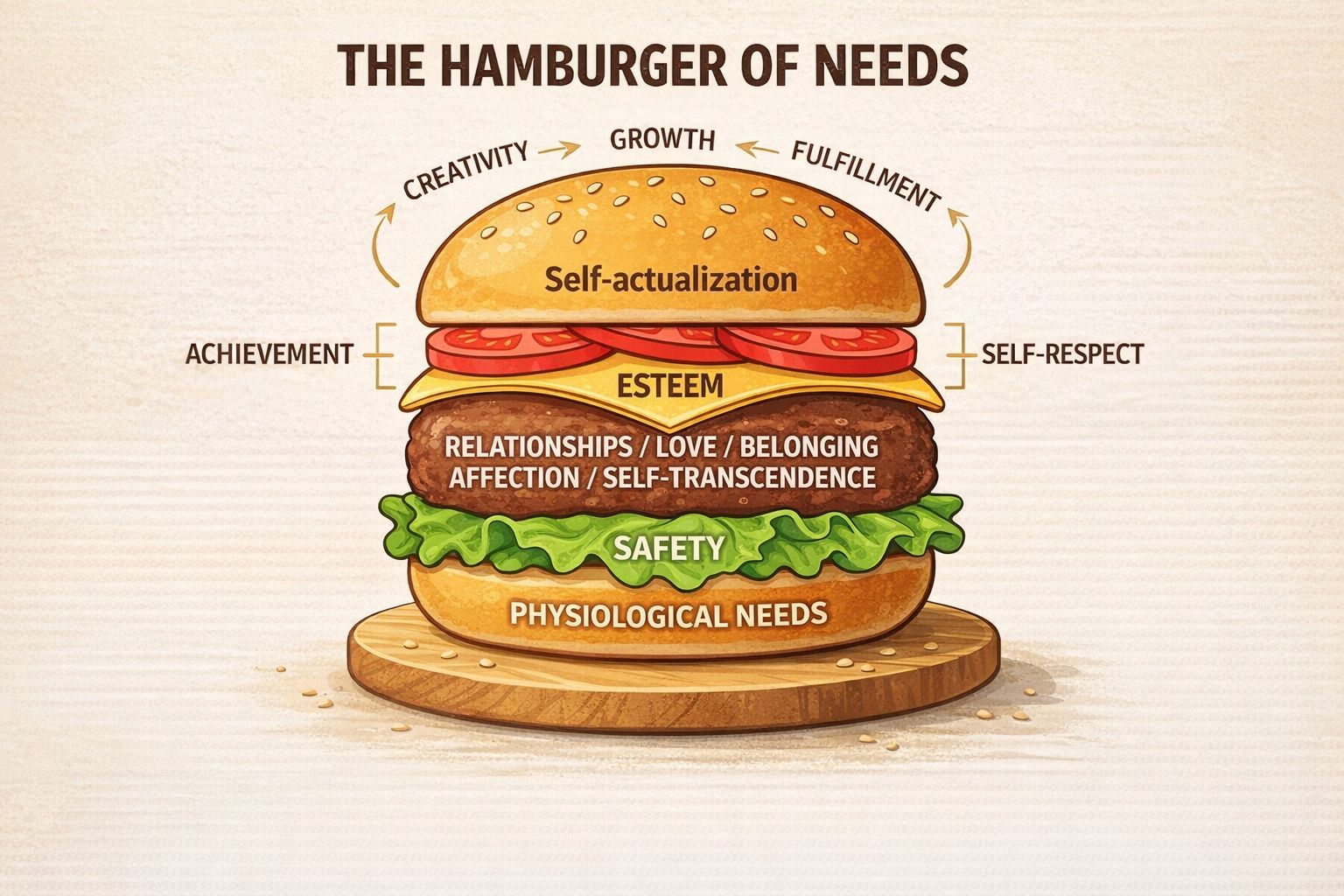
Ferriss offers a reframe he calls the Hamburger of Needs. Forget the pyramid. Put relationships at the center — the meat. Everything else — achievement, productivity, self-improvement — is just the bun. It serves the middle. It has no value on its own.
My wife, on her morning run, isn’t optimizing. She's in a relationship with her body, with the morning, with herself. The watch just helps her listen.
Me, at my laptop at midnight, faster than ever, failing more people than ever? I had the bun. I lost the burger.
"Not everything that matters can be measured. And not everything that can be measured should be maximized."
Psychologists call what disappears under extreme optimization "the space between" — unstructured time, boredom, daydreams. The research is consistent: these formless gaps aren't wasted time. They're where creativity lives. Where connection happens. Where you remember who you actually are when nobody's measuring you.
The question isn't whether AI will make you more productive. It will. The question is whether you'll let it eat your space between, or use it to protect it.
The pebble

The challenge
You've been given a superpower this year: the ability to do more, faster. This week, the challenge isn't to use it. It's to protect what you find on the other side.
1. Name your one thing. What's the activity in your life that, like my wife and her Garmin, you do purely for the love of doing it? Write it down. Actually write it. One sentence.
2. Schedule it like a meeting. Put your one thing in your calendar this week with a block that cannot be moved for a client call or a deadline. Twenty minutes minimum. No phone. No checking.
3. Say no to one expansion. This week, when you feel the pull to take on one more thing because you now can do it faster — pause. Ask the Fisherman Test. You don't have to fill every hour you reclaim. Reclaiming it is the point.
The fisherman didn't need a five-year plan to be happy. He needed an afternoon and a guitar. This week, find your afternoon.
Until next week,
Saving Sundays
P.S. Please consider forwarding this to a friend to help grow our subscribers. Think of who it might resonate with, who might need to hear it, and who you could help get out of their funk.
